
What is USALI and why is it essential to manage your hotel’s profitability
For years, fragmented reporting, inconsistent criteria, and reliance on manual processes have been the norm. Today, the context has changed: profitability is built on data and control. This is where USALI (Uniform System of Accounts for the Lodging Industry) comes into play—an international standard that establishes a common financial language for the hospitality sector. This new environment demands a more rigorous approach: data must not only be accurate, but also traceable, actionable, and aligned with variables that have traditionally been excluded from financial reporting.
Interpreting data goes far beyond reviewing a monthly report. It requires understanding what lies behind each deviation, identifying patterns, and, above all, translating that information into concrete decisions. It means moving from a descriptive approach to an analytical one—and ultimately to a predictive mindset. What is the difference between an asset that grows and one that stagnates? The ability to interpret data through USALI.
The challenge is no longer USALI itself, but execution: from accounting standard to strategic tool
Adopting USALI across your hotel portfolio is not a matter of compliance—it is a strategic decision. Its value lies not only in structuring revenues and costs under a common framework, but in what it enables: comparing assets, understanding deviations, and, most importantly, making more precise decisions. When properly implemented, USALI eliminates ambiguity in data and raises the level of rigor across the entire value chain—from operations to ownership.
However, there is a key nuance: working with USALI does not guarantee results. The difference lies in the ability to transform this standard into a true management system. Because despite its evolution, the main challenge remains the same: implementation. In this context, the real challenge is not adopting a standard, but integrating it effectively into day-to-day operations—eliminating friction and turning data into a genuine competitive advantage.
Our experience shows that there is no direct correlation between revenue volume or asset size and the actual quality of management. In fact, in many cases, the opposite is true: larger structures tend to conceal inefficiencies that remain invisible until they impact profitability.
After more than 17 years as independent operators, we have seen large-scale assets operating without a standardized framework such as USALI, relying on ad hoc reporting that is difficult to compare. At the same time, smaller hotels, with more limited resources, have adopted a far more rigorous financial discipline—using USALI as an active tool for management, control, and decision-making.
From a financial control and management perspective, this has a direct impact: deviations are identified too late, margin analysis lacks granularity, it becomes difficult to isolate improvement levers, and ultimately, decision-making is driven more by intuition than by evidence. Without traceability, there is no control; and without control, there is no real asset management.
The key question, therefore, is no longer whether you are using USALI, but whether your organization is truly prepared to make it work. The real challenge is not the data itself, but what you are capable of doing with it. It is about being able to visualize, in real time, the financial and operational reality of your asset—without friction or misinterpretation. It is about detecting deviations before they become problems, optimizing resources with clear criteria, and protecting profitability. And above all, it is about anticipating decisions, leveraging advanced analytics and intelligence that goes beyond traditional reporting.
Do you really know what is happening inside your own business?
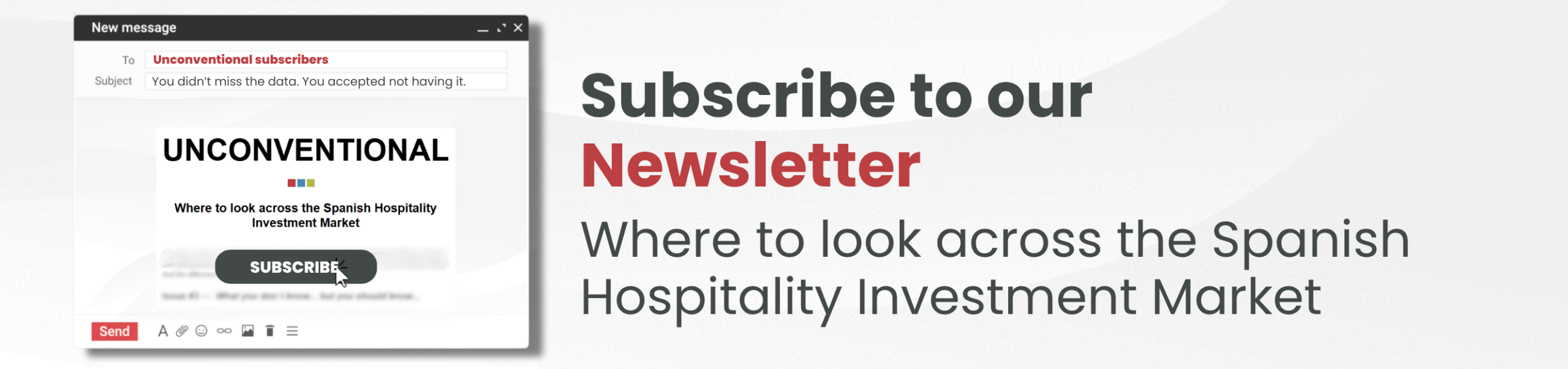
Unconventional: A strategically driven publication under the claim “Where to look across the Spanish Hospitality Investment Market.” Not a market report, not a forecast, not a commercial piece. A brief, reflective note designed to point out where to look in the Spanish hotel market at each stage of the cycle—dynamics, tensions, and opportunities before they become obvious—bringing context and judgment beyond aggregated data.
📩 Join the VIP list: Subscribe no