
8 trends to lead the change in the hospitality sector in 2026
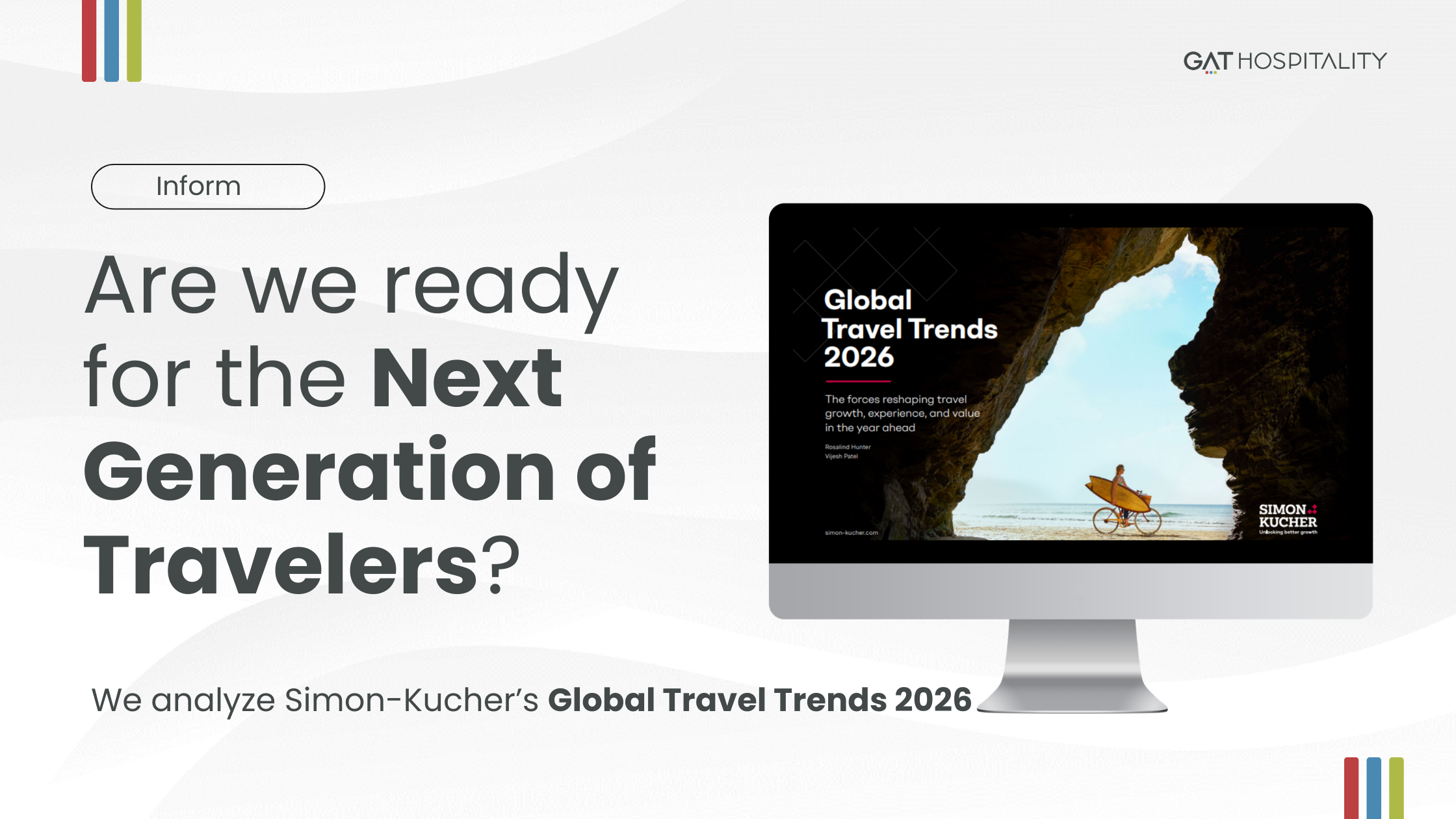
The global travel market is not merely recovering; it is undergoing a structural mutation. According to the latest Global Travel Trends 2026 report by Simon-Kucher, we are entering a new cycle driven by an unprecedented generational shift. Today, market leadership is no longer measured by physical assets, but by strategic agility: it belongs to those capable of capturing the traveler’s attention and converting it into an irresistible value proposition, with balanced pricing and a loyalty earned not through points, but through memorable experiences.
But how do we ground this in operations? At GAT Hospitality, we analyze the 8 trends reconfiguring our sector and the strategic keys to staying ahead:
1. The New Engine: Gen Z and Millennials
Younger generations have established themselves as the primary market drivers. Nearly 60% of these travelers took two or more long vacations in 2025, and their budgets continue to grow: 19% of Gen Z expect to increase their travel spending by more than 20% by 2026. Their travel frequency now offsets the higher spend-per-stay typically seen in more senior profiles.
- Challenge: Building loyalty with a traveler who travels more but is extremely demanding regarding the alignment between their personal purpose and brand values.
- Opportunity: Designing value-based experiences (sustainability, community) and communicating them through visual narratives across digital channels.
2. Wellness as a Personal Investment
Wellness tourism remains a premium choice; 58% of high-income travelers plan such a trip in 2026. However, interest is surging among the youth, who are willing to pay up to 36% more for health and relaxation experiences.
- Challenge: Overcoming the perception of wellness as an exclusive luxury service to capture the growing base of younger clients.
- Opportunity: Developing more accessible wellness formats (mindfulness or wellness packages) without losing the aura of exclusivity that defines the category.
3. The Last-Minute Booking Phenomenon
Booking windows are shrinking drastically. Nearly 50% of Gen Z and Millennials confirm their trips just four weeks before departure, delaying their decision in anticipation of last-minute deals.
- Challenge: Maintaining revenue predictability and occupancy in the face of a client who believes that waiting is rewarded.
- Opportunity: Implementing incentives that pull demand forward, such as “early bird” discounts combined with total flexibility—the most valued factor for accelerating the decision process.
4. Consolidation of Direct Channels
While OTAs remain strong, online direct channels are the preferred method for 52-65% of global travelers. In markets like Spain, 69% of bookings are already made directly.
- Challenge: Competing against the usability and marketing investment of major digital platforms.
- Opportunity: Strengthening your direct presence to convert brand traffic into loyalty; ensuring a friction-free booking process that guarantees the best price and exclusive advantages (upgrades or additional services).
5. The Sustainability Ceiling
Although 62% of travelers claim to prefer sustainable options, the reality is that very few are willing to pay a significant premium for them. This commitment is particularly sensitive in Europe, where price sensitivity remains high.
- Challenge: Implementing genuine sustainable practices without allowing the additional cost to become a barrier to booking.
- Opportunity: Integrating sustainability organically into operations (energy efficiency, local sourcing) and communicating it as part of the hotel’s core value.
6. AI as the New Planner
AI has evolved from a curiosity into a real planning tool: 42% of travelers used it in 2025 to design itineraries, seeking time savings and personalization.
- Challenge: Achieving positioning within the recommendations of AI tools like ChatGPT, Gemini, or Co-Pilot.
- Opportunity: Creating “AI-readable” content; investing in context protocols that allow these tools to access your pricing and availability in real-time.
7. Active Rejection of Overtourism
Concern over overcrowding has grown 7 points since 2024. Travelers are now actively avoiding saturated destinations. There is growing support (44%) for controlled entry systems or tourist taxes that improve the overall experience.
- Challenge: Preventing destination saturation from negatively impacting the perception of quality and price of your hotel.
- Opportunity: Actively promoting incentives for travel during low-demand periods and suggesting less crowded local alternatives to improve guest satisfaction.
8. Loyalty through Simplicity
Loyalty programs are experiencing a renaissance thanks to younger demographics. Success lies in removing barriers: frictionless digital sign-ups attract more than 50% of these users.
- Challenge: Capturing the loyalty of a client who values ease of use and immediate rewards over long-term status.
- Opportunity: Simplifying the loyalty program enrollment as much as possible and integrating it fully into the online booking process; the goal is to reward the lifetime value of the client.
Our Mantra: The Future is Managed, Not Awaited
At GAT Hospitality, we specialize in decoding the complexity of global trends to translate them into precise roadmaps for our assets, turning agility and operational efficiency into the true drivers of profitability.
Understanding this new paradigm requires an expertise consolidated over 17 years of market leadership; a vision where analytical rigor coexists with human sensibility. This differential perspective is only forged through direct management and excellence in daily operations, successfully handling both owned and independent assets. Rather than predicting the future, our work is to ensure that every strategic decision strengthens a solid, resilient, and sustainable competitive advantage in the face of market uncertainty.
WE KNOW HOW